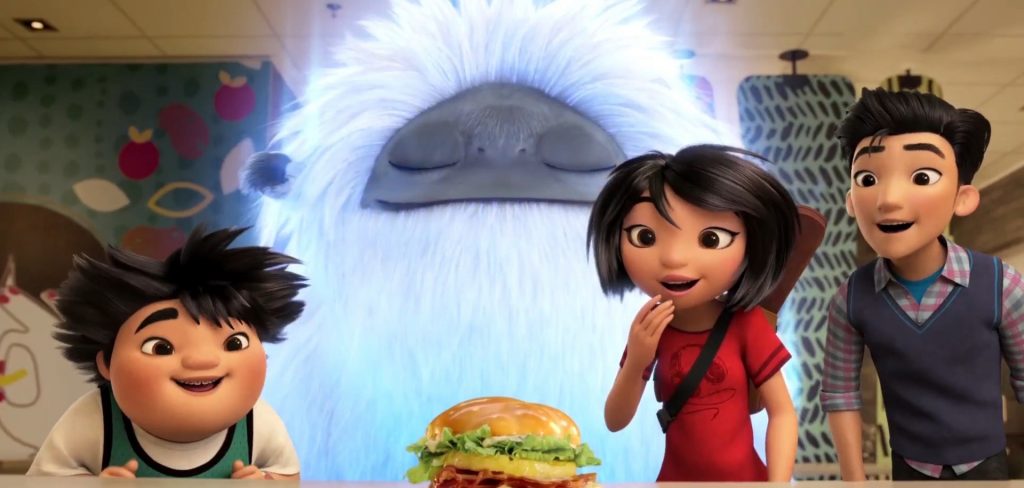
abominable
Look development for a white hair shader is always challenging, especially when the groom covers most of the character’s body. Maintaining believable shading, variation, and readability across such a large amount of hair requires careful control of specular response, roughness, transmission, and density.
The simulation itself is also demanding. A full-body groom creates many areas of potential self-collision, particularly around the arms, shoulders, neck, and head, so these regions require additional attention during setup and testing.
Another important consideration is how much hair actually needs to be simulated. For this type of groom, it is often more efficient to simulate a reduced set of guide hairs and then use those guides to drive a much denser final groom.
The simulation quality can also be adjusted based on camera distance and shot requirements, rather than always running the most expensive setup.
For this project, I used a multi-stage feedback workflow. A smaller set of guides is simulated first, and the result is then used as input to drive a larger group of hairs. That result can be passed into the next simulation stage, gradually increasing the amount of detail through several iterations.
This type of layered simulation approach makes dailies and iteration much faster, reduces compute and render-farm pressure, and still preserves the final visual quality. In many shots, the difference between a very dense full simulation and a well-designed guide-driven setup is not noticeable in the final image.
The main goal is to find the right balance between simulation cost, iteration speed, and final image quality, rather than using the most expensive setup by default.